
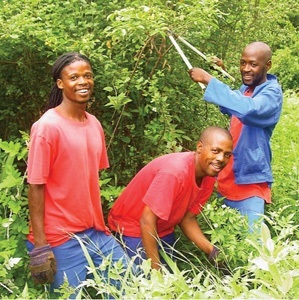
If invasive alien plant identification and removal sounds like a chapter from Day of the Triffids, think again. Cate Clarke finds out more about this non-profit project started by the Everton Conservancy.
For Everton resident Joan Rout and her dedicated IAP eradication team, tackling green “nasties” is all in an ecological day’s work. “As the IAP project co-ordinator, my mission is to eradicate as many invasive species as possible, not only in the Everton area but also throughout the upper highway,” says Joan, whose unwavering war on the gum, camphor, ginger and bugweed, to name a few, is beginning to take root.
“Urgent alien eradication plans were needed if we wanted to preserve the biodiversity of indigenous vegetation in the many streams that flow through Everton into the reserve,” she says.
Conservation experts say the unchecked growth of alien and exotic plants in the Everton Reserve will continue to have a negative impact on the area’s wild inhabitants which rely on these valleys as natural corridors for food.
“A few years ago the conservancy committee employed several local gardeners on their days off and trained them in IAP identification and removal,” Joan tells me. The initiative was so successful that the conservancy branched out in 2008 after repeated requests to control the infestation of unwanted greenery on roadside verges.
“We tagged the areas with chevron tape as a way of drawing attention to the plants, and people in the area showed great interest in this and asked for plant identification on their properties as well.”
The conservancy now offers IAP identification visits, made possible by the Everton residents’ monthly contributions to conservation work.
“A team member is assigned to the property and will tag every invasive plant and write up a report on what they find.”

People also have the option of removing the plants themselves or using the service provided by Joan and her team.
Property owners are asked to make a commitment to follow up, because seeds continue to grow for a long time after the plant is removed.
“It’s been my experience that when people see the environmental rewards reaped from a garden that’s been cleared of alien vegetation, they never look back,” says Andrea Abbott, chairman of the Everton Conservancy.
“It’s an inspiration to us to see more upper highway residents becoming aware of the responsibility that falls on them as owners of environmentally sensitive properties.”
Fact file:
The IAP Eradication Team: –
* Is guided by the Conservation of Agriculture Resources Act, which indicates the status of invasive plants and how they should be managed;
* Deals with requests to remove exotic species;
* Assists with indigenous tree identification and grassland management.
* Trains ground staff at schools in the identification and management of the IAPs;
* Works with neighbouring conservancies;
* Recommends the Invasive Alien Plants in KZN: a Wildlife Handbook, by WESSA (Wildlife and Environmental Society of South Africa).