
Robin Lamplough delves into the past of Hillcrest.
David Fregona arrived in South Africa from Italy late in the 19th century. He travelled to Emberton, the farm of William Gillitt on the main route to the interior. There he entered an agreement to take over a trading store called the Waggoner’s Rest, which stood somewhere in the vicinity of the present Oxford Centre. According to research by local journalist Julie Claxton, David Fregona was born in Belluno, Italy, in 1867. He and two brothers left home in search of better prospects, each going to a different country with a view to exchange information on prospects. There is no evidence that either of his two brothers also moved to South Africa.
At the time that David settled in the Hillcrest area, important changes were taking place here. A Durban estate agent, Ernest Acutt, had just concluded an agreement with Gillitt to sell plots to well-to-do Durbanites wishing to escape the summer heat at the coast. This arrangement would provide Fregona with several opportunities to expand his operations. When the railway reached Hillcrest, he opened a trading store opposite the station, where the Elangeni Centre is today. He started a dairy farm near the present Hillcrest High School and supplied many householders with milk daily. Julie Claxton reports that David Fregona and his wife had six sons and two daughters. Sheila Gillitt attended a local school with the daughters. My current telephone directory reveals only one resident with that surname, living in Kloof.
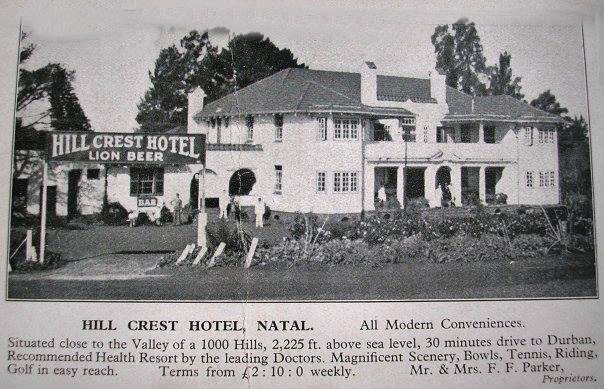
Without doubt David Fregona’s greatest contribution to the growing population of Hillcrest was the building of a hotel on the main road. It became a social centre for the people of the community. Sheila Halstead has left graphic details of the way, in earlier times, celebrations and entertainment had been provided in a wood and iron hall where the present civic centre stands. After the hotel was built, young people played tennis on the courts on Saturday afternoons and often attended a dance in the evening. Travellers from the Transvaal found the place a convenient overnight stop and locals, in the automotive age, enjoyed a drive into the country at the weekend. In those days, too, it was unheard of to drive between Durban and Pietermaritzburg, or vice versa, without a stop for tea, and the Hillcrest Hotel was a favourite venue. This building has been incorporated in the Colony Centre.
The only surviving memorial to David Dominic Fregona is St Dominic’s Catholic Church, in Mill Road. It is very likely that even regular congregants there are not aware of the connection. Joy Brain, in her account of the archdiocese of Durban published in 2010, records that Fregona donated land for the church, which was opened in November, 1936, and named after St Dominic. It stood between the railway line and the R103, or Old Main Road, which was by the 1960s an inconvenient spot for local Catholics. In 1965, money was donated for a new church closer to the centre of the town, but a dispute with local authorities delayed the project until 1968. The church was opened in 1969.
David Fregona made a significant contribution to the development of Hillcrest at a time when it was an independent community and not part of the eThekwini megacity which evolved in the later 1990s. I believe that his role deserves to be recorded, not just for nostalgic reasons but in order to help the present generation understand something of its roots. I would be very sad if my grandchildren grew up believing that the status quo was how things had always been.