
FOR WOMEN, WHETHER THE GROUP’S CORE INTEREST IS BOOKS OR FOOD, IT BEGINS THERE, BUT ENDS IN SO MANY OTHER PLACES
Story by Anne Schauffer and pictures by Sally Chance
There’s a strong urban legend around what really happen in women’s groups. And yes, no denying the fun – sometimes food and wine – but that’s the surface. When you join a group which connects, those women become an integral, indispensable part of your life. Melodramatic? Not really.
Deborah Hulme is a counselling psychologist in uMhlanga: “The bonding in women’s friendships is unique, on a par with our romantic relationship in terms of their power to impact our lives. Women understand each other; our brains are wired up in a similar manner and we share a similar world view. We identify with each other and validate each other, as we face unique life experiences.” That doesn’t mean women automatically connect in a group. Those who don’t contribute or receive anything from it, normally drift away, and a core remains.
Heather Fitchet runs an art studio, with one evening class: “This particular group is a powerhouse of women, who either run their own businesses or practices, head up schools or hold high powered positions within their companies. Given these incredibly strong personalities you’d think there’d be clashes/fallouts/posturing and competition, but that is where this group is completely unique.
“We have grown stronger and closer as the years have passed. We’ve laughed so much, wept many tears, ranted and raved, shared joy and absolute devastation, walked alongside those who have lost children, who have children struggling to fall pregnant, held hands through emotional pain, make ups and breakups. We have drunk a lot of wine.
“The art studio is more than art – it is a safe, non-judgemental space – the best place, a gathering space for the best sisterhood. And yes, we do create masterpieces – on canvas and in our lives.” Non-judgemental and safe. The mantra is, “What happens in the art room, stays in the art room”. And it really does. As Belinda Davies says, “It’s a safe space in which the women involved have been held through some real tough stuff – and the love and support is never in doubt.”
Durban-North based Tia Wiblin facilitates groups around her business and passion, Innate Healing, but one female group developed into a strong friendship. They’ve been meeting regularly for 10 years, and Tia’s part of them: “There’s something about sharing in a group – a deeper level of learning. When you talk and listen to others talking, you might realise they’ve said something you couldn’t say, or identified something you were experiencing but didn’t know how to articulate, it’s that kind of stuff which emerges from group sharing.” Tia says the longer a group has been running, the more connected and developed it is: “The sharing capacity becomes more advanced, and that definitely makes a difference. When the bond has been forged over tears and happiness and joy, the sharing is much deeper and you get more out of it.”
She laughs, “There’s a lovely little anecdote about how men and women differ: a man walks up to a tree, looks at it, and says, ‘That’s a tree’. Women walk up to a tree, scratch at the roots, sniff the bark, pick a leaf, walk around it, then agree, ‘It’s a tree’.
Maria Correia is part of this group: “I’ve never really had a huge group of friends, always been pretty much a loner. When I met these girls, there was a real connection because we were like-minded. We have delicious conversations about so much, and we’ve become close. They’re very non- judgemental, and even during all I’ve been through this past year, they just held me. It’s a very sacred space, and whatever goes on in these groups, we don’t gossip with our partners or our family – we know it’s a very safe space.”
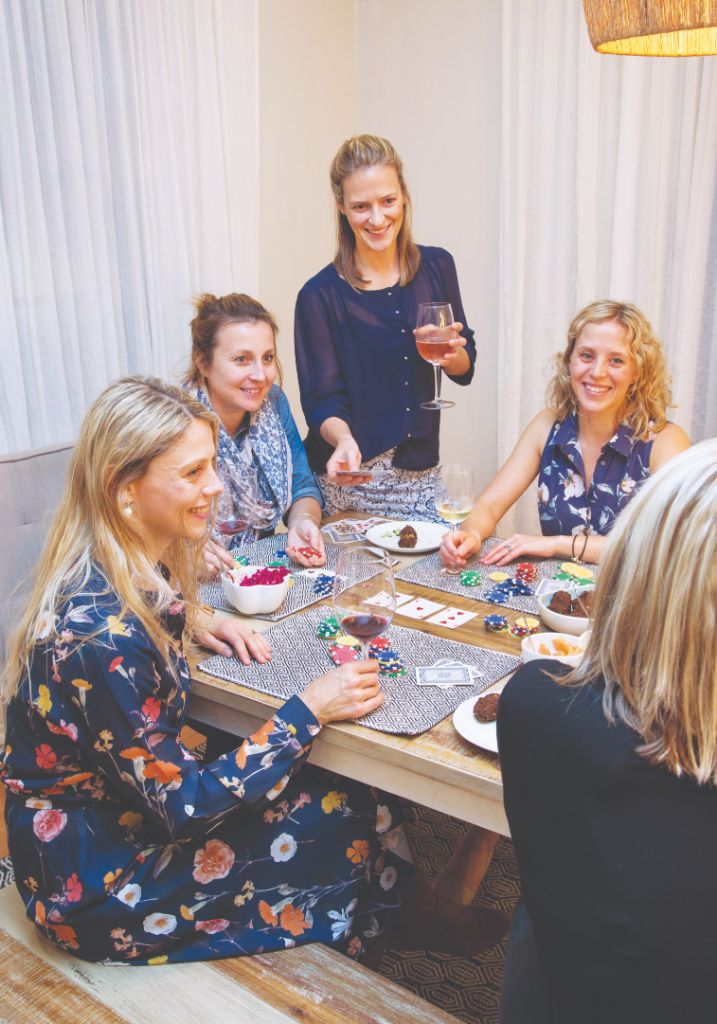
North of Durban, the Fromance (vroumance) group of 30-something year old girls is about “experiences”. There are 10 of them, husbands are friends, and it was perversely kick-started by the husbands group – Bromance. Kendall Snyman laughs, “They met up once a month for dinner, created a Whatsapp group, and had an awesome time … while we babysat. I messaged the WAGS (wives and girlfriends) to set up Fromance. We decided the hostess would choose the ‘experience’ … and we’ve had everything from yoga to poker.
“Our first was pottery, and although few masterpieces emerged, we learnt things about each other … who was the crafty one, who the serious one. We had an art evening, and the person we thought was the least creative, stunned us with the most beautiful piece of abstract art. It’s a meet- up with a purpose, and I so look forward to that time with these girls.
“We’re all similar, like each other, our husbands are friends, kids are similar ages doing the same thing, and we’re all working and trying to get by. You can spend two hours bitching and moaning guilt-free, or giving support to someone else, or just laughing, whatever. We’ve had evenings where somebody is going through something difficult, and we’ve spent the entire evening supporting her, giving advice, making her laugh …”
Richelle Montgomery is part of Fromance: “I think what we all get out of it is the support, and confirming that all the mothering things we go through are normal! As well as just having some ‘me’ time to see your friends!”
Bookends book club is 30 years old, and the age range is wide – 30 to 75. Mette Bunyan is one of the original members: “Right from the start, it was not going to be a ‘who can make the best dinner’ – it was about books and friendship – nothing competitive. Our members’ interests were diverse, ranging from Doris Pressley, who was into kung fu and anything martial arts related, to occupational therapist, Kate Rogers who was absorbed by anything around disturbed kids. I love our diversity, and the ease with which we share with each other.”
Members of the group have moved cities, emigrated, died, and new members joined. Tassie Kougianis is a younger member, “Conversations that arise from reading books – and the group itself – vary significantly from those in daily life. Far more wisdom and life experiences around me at book club, than anywhere else I know.”
Niki Armstrong joined Bookends as a way of making friends who loved reading, and providing a much-needed break from work and two small children: “I did, indeed, make new friends – interesting, talented, funny, hospitable, courageous women, who shared their triumphs and disasters with complete honesty throughout the years. Women who accepted each other with very little judgement. There are national and international members who update us (very artistically) on their lives and reads.”
Bookends’ founder Roberta Smith lives in New Zealand, but she’s still an intimate, albeit absent, member of the book club: “Besides the obvious book talk, a book club can be a comfort through life’s challenging times: raising kids, divorces, marriages, career switches and ageing parents. We’re getting older ourselves – at last month’s meeting, arthritis had its little moment in the spotlight.” She adds, “Even though we don’t always agree on a book (and passions can run high), my book club is my Happy Place and my book club ladies, worldwide, are my friends. You can’t say better than that now, can you?”
And it’s not just about support for past and present, but future. Tia Wiblin believes people become empowered together, that’s what makes these groups so amazing: “You feel like you have a tribe routing for you, and that inspires you to go further, be a little braver, go beyond your comfort zone, knowing all the while, you have their absolute support.”