
story hayley dennyson photographs roxanne davison
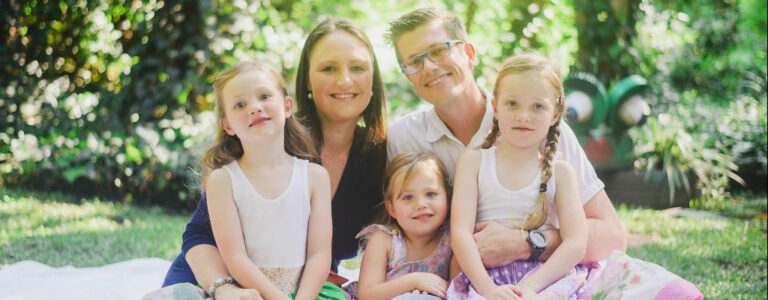
Imagine having three children under the age of two. Now imagine living in rural KwaZulu-Natal, five hours from your closest friends and family. Finally, imagine that those three children are deaf.
Doctors Bianca and Graeme Birdsey moved to northern KZN in 2010 to complete their community service, but enjoyed it so much that they stayed on, welcoming their twins that year and a third daughter just 22 months later. They knew that raising a family would be tough, but the twins were difficult and Bianca had an uneasy feeling she just couldn’t shake.
“When they were 18 months old, I was concerned that they weren’t speaking, but it was not easy to find someone who took our concerns seriously,” Bianca recalls. “The girls would sometimes respond to my voice, but not always, and it seemed that anyone could soothe them as well as I could. Was I a terrible mother?”
By the time the girls were two and a half, Bianca was significantly concerned and contacted an audiologist, who agreed to do a phone consult. She talked Bianca through a range of exercises to do with the twins, but concluded that there was nothing wrong and asked Bianca to get in touch when they turned three. “That was the worst advice we could have been given.”
Every day, 17 babies are born deaf in South Africa. While this needn’t be a disability, tragically, for many it is, as late diagnosis robs them of the chance to gather language in the vital first three years, after which communication becomes more difficult. Without language a child is unable to think, seriously hampering their development.
Newborn hearing screening is not compulsory in South Africa and will only be done if requested by the parents or if the baby is considered high risk. Astoundingly, it seems that doctors and even ENTs are taught little about deafness. “Even as a doctor with paediatric experience, I didn’t know what to look for,” Bianca explains. “We had no family history of hearing difficulty and the girls seemed to respond to sound, so I never considered that they might be deaf.”
Just before the twins’ third birthday, Bianca realised one of them was deaf. “We were away on holiday and I heard one of the girls screaming in the garden. She was looking for me, but didn’t respond when I called her, even when I screamed behind her. It was only when I touched her shoulder that she turned and dived into my arms.
We had both girls tested and discovered that not one, but both were profoundly deaf,” Bianca recalls. “That was a traumatic day; the start of a very dark period in our lives.”
The couple resigned immediately and moved to Hillcrest, where they could access the specialists they needed for their daughters. “We had no experience of deafness and no idea where to go. We weren’t referred for counselling and had to mourn the loss of our ‘normal’ alone.
“It was sheer coincidence that I came across a pamphlet for Hi Hopes and, in desperation, called the director late at night. We spoke for ages and she shared practical tips and advice that gave us our first glimmer of hope!”
Two months later, the Birdsey’s discovered that their youngest daughter was also deaf. After coming to terms with the diagnosis, Bianca and Graeme threw language at their daughters in every way possible. They developed strategies to make up for lost time and, while they were initially hesitant to try sign language, it has provided an invaluable tool for the girls’ natural development.
“There’s no ‘one size fits all’ solution to deafness and it’s important to follow your child, creating a framework that fits with them. We made a decision to integrate them with the hearing world from a young age and coach them through difficult situations, so that they can move forward, knowing that they can cope,” Bianca explains.
The Birdsey girls have made incredible progress over the past two years, growing in confidence and letting their personalities shine. Bianca and Graeme have learnt a vast amount too and have made it their mission to help others in the same situation.
“Hearing screening should be seen as a human right,” says Bianca. “Late identification of hearing difficulty bars a child’s access to language, creating a disability where there is no need for one.”
The couple have established THRIVE, which works in association with Hi Hopes to offer unbiaised support to families as they go through this journey, as well as engaging with professionals to increase awareness. “Early detection and parental involvement are key to a successful outcome,” Bianca continues. “We campaign for compulsory testing, encourage parents to trust their gut and doctors to refer to others if they are not sure. If you have any concerns about your child, get them tested!”
Since September 2014, THRIVE has supported over 250 families, with teams in KZN and Gauteng, and a website providing a valuable tool to families of deaf children across the country.
“It was my dream to sit around the dinner table discussing our highs and lows of the day,” says Bianca. “That’s happening. Our girls know they are loved, that they have a special purpose and that we will fight for them and teach them to fight for themselves. It’s not what we imagined, but we wouldn’t have it any other way. Our girls are going to change the world.” *
[To use with sign language pics] Let’s connect
The 2016 Talk Sign campaign appeals to 13 to 25 year olds to reach out to those who are deaf or hard of hearing.
“You play the same sports, you share the same interests, you just speak a different language, so do what you need to do to communicate by learning sign language,’’ encourages Shamila Surjoo, Director of the KZN Blind and Deaf Society.
Talk Sign Day 2016 takes place on Friday, March 11. Buy a Talk Sign sticker for R10 and wear it to show your support.
Contact Ellisha Chengan from the KZN Blind and Deaf Society on 031 309 4991 or ellisha@talksign.co.za.