
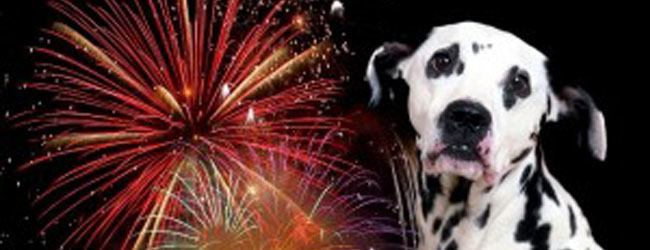
Domestic dogs and cats rely heavily on their sense of hearing to locate prey and danger, and to communicate. Cats and dogs are able to hear a wider range of sounds, and softer sounds than humans. Imagine, then, what it’s like when fireworks are exploding across the sky?!
Dr Yesh Govender from the Kloof and Highway SPCA gives his tips on caring for your pets during this traumatic time.
1. It is critical to identify your pets with both tags on their collars as well as microchips, which are easy to apply and it is quick to identify and locate owners if your pet goes missing.
2. It is good to keep pets in a room which they are familiar with. Familiar smells, sounds and sights will relieve anxiety.
3. Place nervous animals with more calm animals as the calmer animals will help reduce the stress.
4. Playing the radio softly and dimming the lights will greatly improve your animal’s mental status.
5. Never tie up animals or place them in rooms with many obstacles as they may cause great harm to themselves.

6. Staffies, huskies, Jack Russels, german shepherds and most terriers tend to suffer from noise phobia more than other breeds. If you own any of these, please pay particular attention to your dogs over this time.
7. It is a good idea to keep the animals in the same room with the members house hold, if possible, as this reinforces their security.
8. Calming collars and DAP plugs are some of the ways to control anxiety. These products mimic the hormone secreted by the lactating bitch and this gives the animal a feeling of contentment and relaxation. This will work well on animals that suffer from only minimal levels of anxiety. The level of calmness cannot be predicted and it is dependent on the individual animal.
9. Rescue tablets and storm tablets: these are herbal products and are commonly used as a substitute for prescription drugs. The dose is approx 1 tab per 10kg and should not exceed 5 tabs per dose. You should start approx 30 minutes before onset of fireworks and repeat in 3 hours if necessary. I have personally noticed that small breed dogs tend to respond better than large breed dogs. These should be used for mild to moderate anxiety.
10. Anxitane and nutricalm: these are amino acids that work on receptors in the brain that induce relaxation. These are not sedatives and are also non-prescription, over the counter drugs. They are, in my opinion, more effective than rescue tabs and should be give three times a day. They are given the day before and on the day of fireworks. The last dose should be give approx 30 minutes before onset of fireworks. Please contact your veterinarian for advice and dosage.
11. Prescription drugs: these drugs should be reserved for moderate to severe cases of anxiety. Animals require a full clinical examination before these drugs are administered or prescribed. The most commonly used drugs are your benzodiazepams, these are not sedatives but do remarkably reduce the anxiety levels of your animal.
For more information, contact the Kloof and Highway SPCA on 031 764 1212 or 073 335 9322 in case of an emergency.