
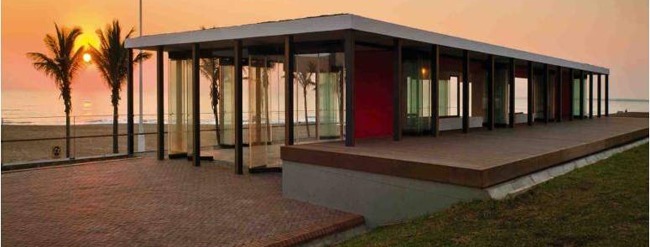
Durban’s iconic Moses Mabhida Stadium, key beachfront nodes and Moyo on the Pier at uShaka Marine World were just some of the projects that received awards at the 2011 KZNIA Awards for Architecture.
During the awards ceremony at the KZNSA Gallery in Durban on 20 October , president of the KwaZulu-Natal Institute for Architecture, Nina Saunders presented awards to a wide range of good examples of design throughout the province. Residential design quality was exemplified by House Throssell at the Zimbali Coastal Estate, House Duke at Hawaan Forest Estate, Indhul Eco House within the Simibthi Eco Estate and The Folie at Gowrie Farm, Nottingham Road.
The Dairy Beach, New Beach, South Beach, Addington Beach and Bay of Plenty Nodes were singled out as examples of good architecture as were the Moses Mabhida Stadium, the Moses Mabhida Commuter Station and the Green Hub at uMngeni River.
The Concierge Boutique Hotel and Freedom Café in Greyville Village and the Clermont Swimming Pool also received awards.
According to Saunders and respected architect and academic Professor Walter Peters, the one building that stood out and received immediate unanimous approval from all six judges was Pietermaritzburg’s Seth Mokitini Methodist Seminary.

Judges were unanimous in the buildings and research project selected to be awarded. Described as “a dynamic African architectural interpretation of the theological outlook of the Methodist Church”, the seminary has already become something of a landmark in Pietermaritzburg.
Judges looked at user satisfaction, the relationship between concept, form and structure, light, colour, textual and spatial qualities and blending with the site and surroundings, as well as environmental performance, energy effectiveness and appropriateness of service systems when making their decisions.

“The awards programme promotes architecture of merit and promotes a greater awareness around the built fabric of our environments. The built environment fraternity has numerous challenges presented by climate change and these awards demonstrate measures architects are taking in addressing these challenges.
“However, the architectural industry cannot work alone. We need to work with Government and to ensure the buildings we design comprehensively meet with requirements. One of the key elements is climate change and we need to design buildings that take cognisance of the changing climate and the need to design buildings which not only reduce our carbon footprint but are energy generating and in symbiosis with the environment,” Saunders said.
Saunders said that the upcoming Cop 17, which is being hosted by Durban, would continue the environmental debate. She said she expected the 2014 World Congress of Architecture that will be held in Durban will also to take this further while focusing international attention on South African architecture.
“It is wonderful that our city is attracting such prestigious international events. Durban Invest, the Department of Public Works and TKZN have all come to the party to assist the Institute with the hosting of one of the architectural world’s most prestigious events, first during our trip to the Tokyo World Congress in September and now during our planning for the 25th World Congress in three year’s time.”
The Deputy Minister added her voice to the call for environmental considerations to take centre stage. “We must save tomorrow today. We need to start changing design and take cognizance of the environment,” she said.