
How often have you heard the terms ‘endangered’ or ‘vulnerable’ when talking about a species of animal or plant? Have you ever wondered how scientists work out which category a particular species belongs to?
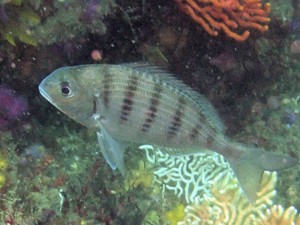
Photo: A white stumpnose, which is listed as vulnerable
Story by Judy Mann
Well, scientists at the Oceanographic Research Institute (ORI) have been working on the assessment of a number of fish species and they can tell you – it’s a long and complicated process.
South Africa is home to many marine fish species from the family Sparidae (sea bream). In fact, we have a total of 42 species of which 31 are endemic to southern Africa and are found nowhere else in the world.

Bruce Mann from ORI and Colin Buxton (University of Tasmania) prepared draft assessments for the 42 sparid species found in South Africa for an IUCN Red List workshop held in Taiwan in 2009.
Following many further workshops to assess the remaining sparid species found around the world (123 species worldwide) and an extensive review process, all the sparid species have finally been assessed and in 2014 were published on the IUCN Red List.
For the 42 South African species assessed, the results were as follows:
- Critically endangered – seventy-four and dageraad
- Endangered – red steenbras, white steenbras, red stumpnose
- Vulnerable – black musselcracker, scotsman, white stumpnose, river bream (perch)
- Near threatened – 6 species
- Least concern – 25 species
- Data deficient – 2 species

White steenbras – endangered
Many of South Africa’s sparid species are important in linefishery (fishing from small boats or from the shore using a handline or a rod and reel) and the fact that some of these species (e.g. dageraad, seventy-four, red steenbras, white steenbras and red stumpnose) are seriously over-exploited highlights the need for careful management of this fishery and other fisheries which harvest linefish species.
The IUCN Red List assessments provide an important tool which can be used improve public awareness and encourage responsible fisheries management.