
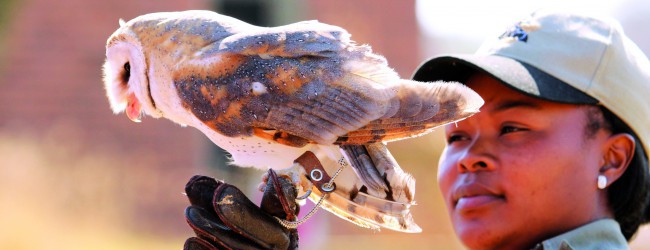
The African Birds of Prey Sanctuary is a haven for these exceptional creatures and a wonderful way to learn more about them.
Photo: Belinda Phetha with Alpha the Spotted Eagle Owl
Story by Andrea Abbott
Birds of prey are a familiar sight in the skies above the Highway area. Among them are some of the greatest of all raptors: for example, the often seen and heard African Crowned Eagle – the most powerful eagle on the continent. And, if you’re lucky, you’ll spot the biggest of Africa’s eagles, the Martial Eagle.
Night brings out the rodent control team: the screeching Barn Owl, the melodious Wood Owl and the mellow-voiced Spotted Eagle Owl that, when first glimpsed sitting on the ground, is sometimes mistaken for a large cat.
According to various bird lists, about 22 different species of birds of prey occur in the Highway area, while in South Africa as a whole, there are 81 species, an exceptional diversity in any terms. Watching the glorious aerial displays of raptors or seeing them soar, as if effortlessly, to great heights, you’d think these predatory birds were invincible.

Yellow-billed Kite that came out of a damaged nest,
was rehabilitated but refused to be released into
the wild.
The opposite is true, though. Birds of prey are in serious trouble and all species are protected in our country. Fully a quarter are listed in the Red Data Book as needing active protection. Threats to them are many and varied, but almost all are the result of human activity.
“Poisoning and the traditional medicine trade are two of the major threats,” says Shannon Hoffman, who runs the African Bird of Prey Sanctuary (ABoPS) in Camperdown. Devoted to protecting birds of prey, Shannon is on a mission to educate people about these important birds and also debunk baseless myths that lead to their persecution. This she does during flight displays she presents at the Sanctuary for school groups, as well as the general public.
“Top scientists are doing great work to conserve birds, but this needs to filter through to ordinary people everywhere,” Shannon says.
The largest facility of its kind on the continent, ABoPS comprises two sections: Raptor Rescue – a behind-the-scenes hospital where injured birds are nursed back to health and ultimately released, and the Sanctuary itself, which is open to the public and provides safe haven for about 40 species of African birds of prey.

rescued from a cage in Lesotho,
doesn’t know she can fly.
Aviaries might seem anathema in the context of a place dedicated to the welfare of birds, but as Shannon explains, those at the sanctuary could never survive in the wild. They’re all either captive-bred (thus imprinted on humans) or non-releasable rehabilitation birds whose injuries have left them permanently disabled. And so, for instance, Sheba the Martial Eagle has a damaged wing that prevents her from steering in flight; Aragon the Long-crested Eagle was hit by a car (a common cause of injury or death in raptors) and can no longer fly properly.
All the birds have a heart-rending tale to tell, but one of the saddest is the story of Nonyani Leseli, an exquisite Bearded Vulture, who from an early age was confined to a cramped cage by a sangoma in Lesotho. Nonyani has no idea she can fly, so now lives in a spacious enclosure designed to make her feel at home. Like all the other birds at the Sanctuary, Nonyani Leseli plays a vital role as an ambassador for others of her kind living natural but imperilled lives. In the case of Bearded Vultures, there are only about 320 birds remaining in the wild.
The birds need human ambassadors too and so a visit to AboPS should be on everyone’s list of things to do. Set in 60 hectares of beautiful bushveld, it’s a great place to spend a day (take a picnic). You’ll come away with a much deeper empathy for those magnificent hunters that rule the air.
African Bird of Prey Sanctuary is off the N3 on the Lion Park Road. Open Wednesday to Sunday 9am to 4pm. Flight displays take place at 10.30am on weekdays and 10.30am and 3pm over weekends and on public holidays.
Group functions, school visits and children’s parties are available by arrangement.
For more information, visit www.africanraptor.co.za or phone 031 785 4382.