
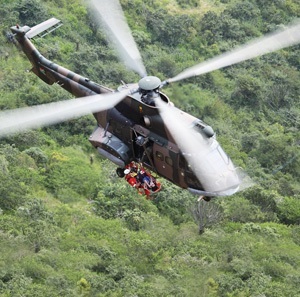
Queasy about heights? Then even looking at the photographs will make you want to hang on to the nearest railing, writes Liz Clarke.
You wonder who in their right minds would jump at the chance of a rescue operation so mind bogglingly dangerous that only someone as foolhardy as Indiana Jones would take it on.
Emergency rescue volunteer, Mark Easton is far from foolhardy. In fact sitting in his neat pad in Plantations, going through photographic records of his team’s extraordinary feats, he is calmness itself. A pharmaceutical consultant by trade, he says he has one passion in life – and that is to save lives.
“And that goes for every member of our team. There is very little that we won’t take on – day or night, whether it’s recovering people from an accident scene on the ground, or rescuing a fallen climber.” The “team” is made up of trained volunteers, like Mark, who belong to the Voluntary Emergency Medical Association (VEMA) a registered non-profit and public benefit organisation, which operates in the Upper Highway area.
Mark explains the working of VEMA: “In short, it is a rapid volunteer-based initial response. We ensure that there are trained people on hand who can cope with medical emergencies, trauma and high angle incidents within the Upper Highway and surrounding areas. The fact that we can get to the scene of an incident before the arrival of full-time emergency services, we believe improves the patient’s outcome.”
It’s the HAR bit tagged on to VEMA that sets the teeth on edge. It stands for High Angle Rescue – and often means dangling by rope from impossible terrains and easing one’s way down steep cliffs or gorges to get to accident victims. Mark is HAR’s Operations Manager.

He explains that the members of this arm of the search and rescue unit are trained paramedics as well as experienced rock climbers. To date the rescue team has been put on standby for many incidents but really only carried out and assisted with two body recoveries with the SAPS SAR and two rescues with 15 Squadron. On one incident the team was required to abseil down a cliff to locate the body of a rock climber that had fallen during a night climb in the Winston Park area. On another occasion the team successfully rescued a woman who had fallen while on a walk in the Oribi Gorge area down the South Coast.
Mark points out that while these are not every day happenings, to be able to work in tandem with the official rescue units means being in peak training condition at all times. I see in one of his photographs dots that look like small flies on a large wall. He smiles. “Yep that’s us going down the side of a cliff in Shongweni Valley as part of an “extreme” exercise.
It’s shudder stuff even though, as Mark puts it: “The equipment we have is state-of-the-art.” As part of the exercise a climber has to be transferred from one rope to another – while dangling mid air. Once on the ground – you can barely see the top of the cliff – the paramedics have to stabilize their patient and place them into a special carrier that is then hoisted into an emergency rescue helicopter. That’s where 15 Squadron comes into the picture.
“We currently train with 15 Squadron almost every month practicing real life scenarios in areas where there is most likely to be an incident, often in the worst terrain you can think of.” The team already does some training with the SAPS SAR unit and their next mission is to do cross training with NSRI.
It’s difficult to believe they are not terrified during these nail-biting aerial exercises. “The last one was done in freezing conditions,” said Mark. “The cold was certainly frightening!”