
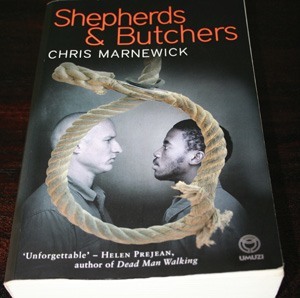
Who knows the price paid by executioners in the dark days of apartheid? Hillcrest writer Chris Marnewick has written a compulsive novel about the trauma suffered by those forced to kill men entrusted to their care, writes Dianne Kerwan.
Gallows Chamber Pretoria Maximum Security Prison: 7am, 14 November, 1989. A young warder let go of the sleeve of a hooded Solomon Ngobeni as the hangman pulled the lever to open the trapdoors in the last judicial execution in South Africa.
In the novel Shepherds & Butchers, this could have been the fate of prison warder Leon Labuschagne, who because of the emotional strain of participating in the hanging of 32 prisoners in two weeks and 164 during the year, breaks down and becomes a killer himself.
The fictitious character is the creation of Hillcrest advocate Chris Marnewick. “Back in 1987 I came across these facts and I wondered what it took to kill in that environment and what sort of people were being hanged back then.” Six years of research plus interviews with a gallows escort resulted in the compelling book. It portrays the trauma of having to kill and bury those entrusted to one’s care during their last days: it also won last year’s Johannesburg University Prize for Creative Fiction in the Debut Category and was shortlisted for the M-Net Prize for Fiction and for its Film Category Prize.
The foundation for the novel was laid when, as a seven-year old, Chris saw a newspaper photo of Clarence van Buuren, murderer of a Pinetown girl, who was hanged in 1956. In high school Chris visited the house where a friend had been beaten to death with a pick-axe. “There was blood everywhere, even on the ceiling.” Years later Chris was to prosecute in Pinetown A Court where the photograph of Van Buuren had been taken. “I think I was destined to write this book,” he says.
Familiar with court procedure, the court scenes weren’t difficult to write. However, after his first book Litigation Skills, a technical handbook for newly qualified lawyers, Chris admits the switch to fiction required some adaption.
The novel has made readers re-examine their views on the death penalty. “Advocates of that era have told me the book has reminded them of their anguish when they defended death penalty cases,” Chris explains. “Others have admitted that they never considered the effect of the execution on those tasked with the killing.” Just as we never think of the anguish of soldiers who have to kill in war.
Chris 
Sitting on the veranda of Chris’s Augusta house, I feel overwhelmed by the contrast between the pleasant surroundings and the harsh concrete and steel I see in the photos of the prison gallows chamber. My hands tremble as Chris hands me a copy of a death warrant. Photos of frayed hanging ropes and a photostat list of hangings since the early 1900s bedeck the table.
His wife Ansie appears bearing a tray of refreshments. I look out on to the peaceful golf course. It’s here where the grey-haired lawyer reads the detective novels of Rankin, Larsson or Mankell. That’s when he’s not enjoying a meal at Oscars or playing his “silent” Yamaha guitar. “I’m a very poor guitarist!” He recently finished his second novel, The Soldier who said No, which is at the printers as I write this.
“Hillcrest and Augusta are as close as we could get to what we enjoyed in New Zealand,” he says. As to why he left that idyllic country, he replies, “Africa is like the Hotel California in the Eagles song: ‘You can check out but you can never leave.’ This place, with all its blemishes, is home.” C
*** Since we published this article, Chris Marnewick has been awarded the K. Sello Duiker Memorial Literary Award, part of the South African Literary Awards. He has also been shortlisted for the Commonwealth Writer’s Prize (Africa Region) and the M-Net Literary Awards, as well as winning the University of Johannesburg Prize for the best creative debut work in English.