
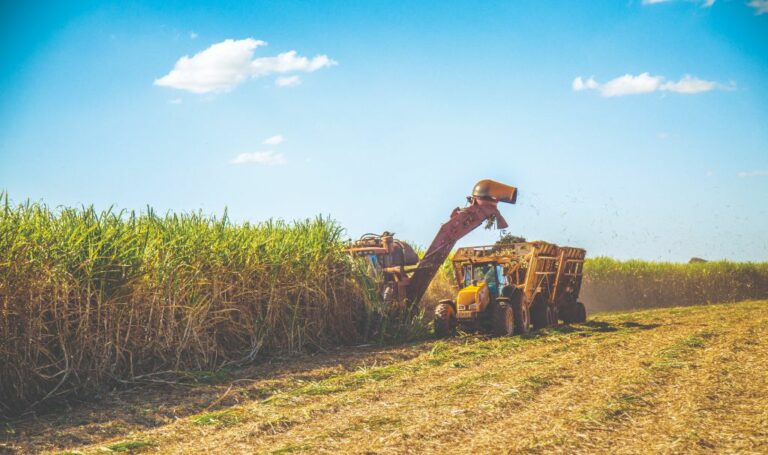
Shirley Le Guern considers the opportunities arising from bagasse.
South Africa’s sugar industry has a long way to go before it benefits from utilising the waste products generated during the sugar milling process. But, this historically rigid and corporatised sector is, at last, responding positively to various opportunities presented by the idea.
Chris Whyte is from the African Circular Economy Network, and is assisting the Mauritian sugar industry to improve technologies to increase the energy output from burning bagasse, the fibrous material remaining after raw sugar has been extracted from sugarcane.
Whyte says local producers are open to both electricity generation and the creation of products that can replace single-use plastics.
Bagasse accounts for 35% of the energy in a sugarcane plant and tons of bagasse is left behind in the sugar refining process.
A large portion of this is burnt to power the boilers which produce the steam needed to create electricity for production. As a result, the majority of South African sugar mills are already self-sufficient when it comes to generating electricity for their own use.
However, experts say most sugar mills have significant spare capacity to generate additional power which could be sold to the floundering national grid.
In addition, the technology currently used is outdated and, with the right incentives and a legislative framework that paves the way for independent power generation, could be upgraded to improve output.
Like South Africa, Australia, Guatemala, Kenya, Uganda, Vietnam and Mauritius also burn bagasse to generate electricity. Market leaders like Brazil and India already operate commercial-scale bagasse co-generation plants.
Tongaat Hulett has said it is well placed to benefit from evolving renewable energy dynamics with the potential to replace its existing power stations with the latest technology, and higher efficiency electricity plants. But, without the enabling legislation in place and a suitable return from Eskom on electricity sales to provide an incentive for investment in the co-generation of electricity at sugar mills, it has, up until now, focused on the use of bagasse and molasses in animal feeds.
Illovo, too, uses bagasse as a bio-renewable fuel source for its factory boilers. At its Sezela downstream plant, plant material is extracted from bagasse to produce furfural, a solvent used in a wide variety of industries including personal care, food and agriculture.
However, it is not only the sugar industry that has seen the value of bagasse which is non-toxic and 100% compostable. Bagasse bio-degrades in 30 to 80 days making it a perfect alternative to single-use plastics made from petroleum-based raw materials.
Sappi’s Stanger Mill is unique in South Africa and one of only a few worldwide to use bagasse as its basic raw material in the manufacture of office paper and tissue wadding. The latter is used by the hospitality, corporate, home and medical industries. Products include two-ply toilet tissue, one-and two-ply kitchen towels, hand towels, serviettes, hygienic wipes, medical wipes and industrial wipes used in dispensers.
Situated along the North Coast of KwaZulu-Natal, the mill taps into a ready supply of bagasse from neighbouring farmers.
According to Sappi, many are previously disadvantaged growers which supports the development of entrepreneurship and contributes to KwaZulu-Natal’s socio-economic growth and stability.
Buying locally also eliminates the need for long-distance road transport, reducing wear and tear on roads, fuel consumption and emissions from trucks.
The mill’s paper machine has a production capacity of 80 000 tons, while the tissue machine produces around 30 000 tons per annum. It also produces 60 000 tons of bleached bagasse pulp for its own consumption per annum.
Tissue wadding is sold to converters who produce industrial and household tissue products. Sappi says it produces a range of tissue papers using a chlorine-free process to ensure finished products are biodegradable, acid-free and recyclable.
According to Whyte, while bagasse is not necessarily suitable for the production of high-grade office papers, it is suitable for use in packaging with at least five companies in South Africa making moulded fibre products for packaging.
Containers, plates, knives and forks and even straws that are suitable for use by the fast-food industry are also made from bagasse.
There is a strong chance that bagasse might even be used to replace plastic in other products, including shopping bags.
In 2017, the Council for Scientific and Industrial Research Polymer and Composite Research Group launched a 100% biodegradable plastic (bioplastic) bag made from agricultural by-products including bagasse.
At around the same time, the Centre for Sustainable Chemical Technologies at the UK’s University of Bath also developed a biodegradable plastic made from sugar and carbon dioxide.
At the launch, the CSIR’s senior materials scientist, Dr Sudhakar Muniyasamy, said he expected this new technology to contribute to the reduction of environmental pollution and even boost local job creation in manufacturing. However, he said the bioplastic formulation and film production process needed to be upscaled to meet industrial manufacturing requirements.
Whyte says that these new technologies are “nice to have” but need to be economical and competitive enough to provide viable alternatives to the petroleum-based products that continue to destroy the environment.