
Over the past few months we’ve looked at various aspects of terroir and how the winemakers work with mother nature. Now it’s time to discover the many different varieties of grapes, so I’ve asked winemakers who have mastered each variety to share with us their knowledge.
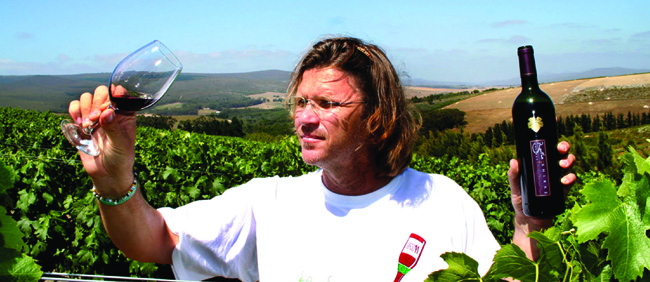
In this issue we’ll look at Sauvignon Blanc, and who better to share his knowledge with us than 2010 Diners Club Winemaker of the Year, Bartho Eksteen from Hermanuspietersfontein Wynkelder. Everyone who knows him agrees that he lives life with passion – a passion that filters through into his five different styles of Sav Blanc.
“Sauvignon Blanc has intrigued me from the days when I started operating in a cooler area, way back when I was winemaker at Wildekrans in Botrivier. Throughout your life as a winemaker you are a student – travelling, meeting other winemakers, tasting different styles of your favourite cultivar, experimenting with different winemaking techniques – and it’s all these elements that contribute to your development as a winemaker,” says Bartho.
There are seven key ingredients needed to create a masterpiece Sauvignon Blanc of distinction and durability: Low pH juice for durability; a juice with a high fruit profile, with a good balance between the two main chemical flavour components (herbaceous and tropical fruit); a rare European minerality; selected French oak from reputable coopers; the incorporation of a certain percentage of Botrytis (a fungus important in wine making) if needed; the legal percentage of another grape variety such as Semillon for extra dimension and pallet weight; and lastly, residual sugar for a good finish.
The cultivar itself is aromatic, displaying different flavour profiles depending on terroir, and comes with good acidity – giving classical minerality and herbaceousness with well integrated portions of ripe fruit in cooler areas, to tropical punch when grown in warmer areas, to full sweet dessert wines if Botrytis cinerea infects the grapes.
“Knowing what can be done with the cultivar encouraged me to experiment with different styles of Sauvignon Blanc. For instance, I always believed there should be a bigger market for wooded Sauvignon Blanc in SA and that winemakers are to blame for not creating that market.
“They consistently used the same wood regime for Chardonnay and Sauvignon Blanc, resulting in Sauvignon Blanc’s becoming over-wooded oak juice because the winemakers didn’t take into account that Chardonnay is much more “forgiving” when it comes to wood than Sauvignon Blanc.
“I spent four years experimenting with different coopers, grains, toasting levels, barrel sizes, ages of barrels, time in barrels and different winemaking techniques until I found the “sweet spot” with Hermanuspietersfontein Nr 5, says Bartho.
Over the years Bartho has come into contact with some very singular Sauvignon Blanc freaks. On his first trip to Sancerre in the Loire Valley in France, he insisted on meeting the late Didier Dagueneau from Pouilly Fumé – described as a risk taker and experimenter, a perfectionist, cutting yields severely to achieve greater ripeness. So of course, Bartho absolutely had to meet him.
“Another very interesting discovery was the wines from Sauternes, which inspired my dessert wine, Hermanuspietersfontein Nr 2 Sauvignon Blanc. I have to confess that I do have a terribly sweet tooth and can’t resist these beautifully balanced, natural, integrated, dried apricot flavoured, nutty, fantastic wines,” continues Bartho.
“Wine is a mystery you can’t predict and an art you can’t measure. Great wine is about nuance, surprise, subtlety, expression, qualities that will keep you coming back for another taste,” concludes Bartho.
Buxtons La Cave Liquors in La Lucia Mall are offering the following Hermanuspietersfontein (HPF) wines on promotion for the month of September 2013: HPF Nr 2 (Noble Late) R130; HPF; Nr 3 (Tropical Sav Blanc) R105;
HPF Nr 7 (Herbaceous Sav Blanc) R85; HPF Nr 5 (Wooded Sav Blanc) R145
*