
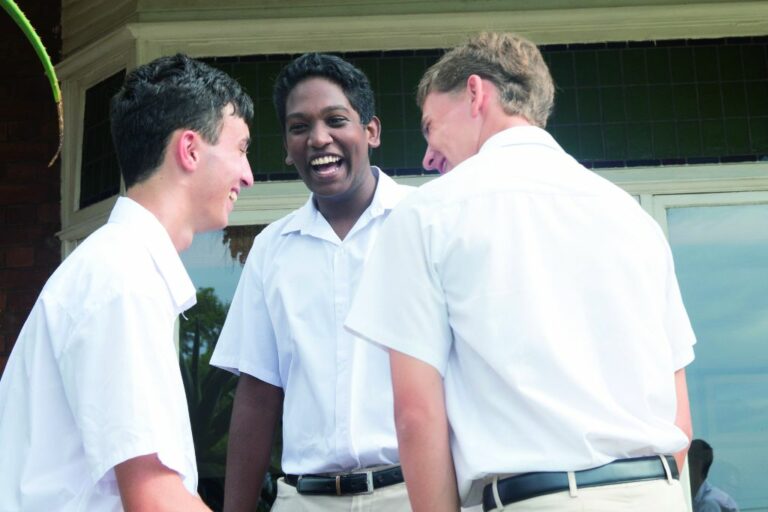
Clifton School is the only independent boys’ day school in Durban. With its unique balance of tradition and modernity, it prioritises the development – and acknowledgement – of each boy as an individual.
As the parent of a young son, the question has to be, ‘What kind of person will he need to be when he steps out into the world?’ And then, ‘What school would nurture those qualities in him, so he is equipped to lead an honourable and satisfying life?’
Clifton first opened its doors in 1924. It was solely a primary school until 2002 when the college was added, growing into a matric class by 2006. Executive headmaster Brian Mitchell considers Clifton’s history as pivotal to the broad ethos of the school: “It’s a 21st century school. We were able to create a thoroughly modern school in its educational focus, and a thoroughly traditional school in its focus on values. We could look backwards to the old-fashioned values of courtesy, respect, tolerance and understanding, and forward to technology and design.”
Clifton School is small. The classes are small. Running from Grade R to matric, the staff has the unique opportunity to contribute to, nurture and watch the development of a boy all the way through.
The fundamental philosophy at Clifton is ‘Happy Children Learn’. As Mitchell says, “If one has an environment of happiness, of safety of person and of ideas, you get the best out of boys. If there’s a respectful, but easy relationship between teachers and pupils, you’ll get proper learning.”
Academics are one thing however, and although Clifton boys do exceptionally well at the IEB matric exam, academic success is considered but one aspect of a superior education. “You have to be a good human being, a fulfilled human being.
“We like to say that being a small school, in order to be competitive, each boy needs to be two or three boys. Each has to count for far more than just himself. And he has to participate,” says Mitchell. And they do. Clifton is competitive in all sports at any number of levels, and is recognised as effective opposition.
That concept of a boy being two or three boys also requires a cultural involvement, and Clifton has exceptionally strong drama and art departments, debating and public speaking presence, and a choir. Mitchell believes, “It’s one of the strengths of a boys’ school that boys are not inhibited to get involved in the arts. We have close to 100 boys in the choir, with many first team rugby boys singing the solos. We have numerous instances of first team captains taking the lead roles in plays.”
Leadership is another of the school’s pillars: “We understand that all of our boys in one way or another, will lead. When they leave here, they need to understand they’re leading in a far broader community than the school one, so their social conscience needs to be honed,” says Mitchell.
When boys leave Clifton and walk out into the world, Mitchell knows they have what it takes to be real international citizens: “That’s increasingly what young people are. They don’t see boundaries or borders. We’re not predicting their potential outside of this school, but we’ve seen boys just fly in areas we hadn’t even begun to think they would approach. That’s exciting, because it means they’ve understood their potential here and been able to take risks elsewhere.”