
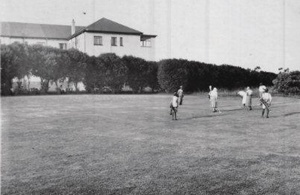
Kloof Country Club has a rich history dating back to 1927, when the nine-hole golf course was officially opened. Debbie Reynolds takes a walk down memory lane …
The golf course is still the heart of the Kloof Country Club, but now it also boasts tennis and squash courts, a pool and a versatile clubhouse.
Recently appointed general manager Pam Mayberry lists her main tasks as “embracing the community” and attracting a younger membership base whilst retaining the club’s traditional values.
Country clubs throughout South Africa face the challenge of dwindling membership – and Kloof is no exception. “Our membership of 1,200 is not bad, but for the club to grow and prosper, attracting new members is imperative,” says Pam.
Being a much sought-after suburb for families wanting to escape the city for more of a “country” lifestyle, she is confident the club has the potential to attract new members.
The club’s rich history is a certain drawcard. This edited version of the club’s background is thanks to current president Kin Elgie and member Peter Quantrill, who acknowledge the publication on the history of the club by the late Des Horne, and the Field family background provided by John Field.
The name Field features prominently in the Kloof Country Club’s history. Thomas Samuel Field presided over a meeting in 1926 when the idea of a golf course on the Field family farm was first mooted.

It was agreed that 50 acres of the farm be devoted to the construction of a nine-hole course. A lease agreement was entered into between Tom Field and the Kloof & District Country Club at a rental of £3 per month. Green fees were 6p for men and 3p for ladies, and caddies were available at a shilling a round.
The decision to extend the course to 18 holes was made in 1928, buoyed by the membership of 223. By the time the first AGM was held in 1935, membership had passed the 500 mark.
According to Elgie and Quantrill, the death of patron and landlord Tom Field in September 1939, as well as World War II, put the club on hold until 1946. Membership had shrunk to 204, and most of the machinery dated back to 1926. “Two ox-driven mowers barely passed muster and if the club captain Mr McMillan, using his influence as headmaster of Highbury School, had not lent us the school lorry for use in cutting fairways, the course may have been unplayable.”
The next year, 1947, brought another challenge, namely the proposed road linking Durban to Pietermaritzburg that would bisect the golf course. The club and Tom’s son, landlord Luther “Skit” Field, opposed the national highway to no avail, eventually losing three holes and the clubhouse.
The newly designed course was completed in April 1951, but the new clubhouse still needed finance. “To our everlasting gratitude, Eric Mowat volunteered to take control. He took leave of absence from his firm for a year and devoted himself to setting the club on a firm financial footing.”
In his honour, the banqueting hall, which accommodates up to 150 guests, is named the Mowat Room.
 Skit Field’s legacy also lives on: he sub-divided and transferred a portion of his land into three trusts to preserve for perpetuity the area’s natural beauty. These were the Fields Park Trust, which received the golf course for the exclusive use of the club; the Luther Field Trust, which received the cricket ground and surrounding area; and the SPCA Trust, which received the old homestead.
Later, the club gained squash courts, a Pro Shop and a Peter Matkovitch re-designed golf course. Having survived a financial crisis in 1998 with the help of a number of members, the club remains a vibrant part of the Kloof community.
 Telephone 031 764 0555 or see www.kloofcountryclub.co.za