
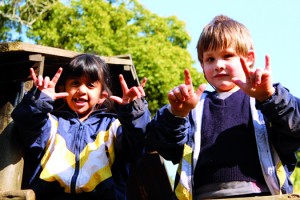
While clambering on the playground equipment, a group of the youngest pupils at Fulton School in Gillitts paused to acknowledge me, their hands signing what I assumed was a greeting. I felt inadequate and could only smile in response. It turned out that they were saying: “I love you.”
By Andrea Abbott
Similarly, when I met children in the older groups, my attempts to communicate with them were embarrassingly clumsy. If I’d had even a rudimentary knowledge of South African Sign Language (SASL), we could have communicated happily, learning more about each other just as everyone does when meeting people for the first time.
Fulton’s students were very patient of my blundering efforts and I left that very special school with a new awareness of the challenges of being deaf. Of all the skills humans acquire, language is unquestionably the most essential – and this is especially so for the deaf.
“Deaf children need to be enrolled in school as soon as they’re potty trained,” Fulton’s principal, Beryl Campbell explained. “Unless we have a solid foundation with the little ones, there is no language for us to build on.”

delighted group of pupils in the brand new domestic
science room
I met the youngest of the school’s 100 pupils. At just two years old, the enchanting little Eden Birdsey seems completely at home in her school. “We’re one big family here,” Beryl says. “We take into account each child’s strengths and weaknesses, and classes are kept small in order to meet specific needs.”
Considered one of the country’s leading schools in deaf education, Fulton draws pupils from as far afield as Cape Town and Botswana. “Many schools for the deaf give just vocational training, but we provide that and academics,” says Beryl. “A lot of our pupils come here to get a good matric. We challenge them to aim high and we’re extremely proud of the school’s 100% matric pass rate.”
Fulton is also one of only four deaf schools in the country offering core mathematics to Grade 12 level.
The education is mainstream and through the dual medium of English and SASL. The latter is set to be an official school subject from the beginning of 2015. “We’re very excited about that,” says Beryl. “It’ll be the second language in deaf schools and will have a CAPS-based curriculum, as do all other subjects.”
Schools that don’t cater specifically for the deaf could also offer SASL, depending on demand. Given that deaf people are increasingly entering the workplace, it seems a good idea for hearing people to learn that language.

Head of Department of the Foundation Phase
With the focus on the holistic development of the child, art and sport are also high on Fulton’s agenda and provide opportunities for the pupils to be integrated into mainstream society. “Currently, several of our children have Provincial and National colours in various sporting disciplines, while we also have teams that compete in the Pinetown and District leagues against able-bodied children,” Beryl explains.
Fulton uses every opportunity to raise deaf awareness and relies on the community and local business for ongoing support, especially as many of the pupils are from extremely disadvantaged families. “Service clubs, individuals, local schools and the corporate community respond generously,” says PRO, Alta du Toit.
One recent example is the refurbishment of a classroom into a domestic science facility. “It was part of a large company’s national Build a Classroom project,” says Alta.
Deaf Awareness Month each September provides another important opportunity for the school to win new support. “It’s becoming an institution for local schools to do something for Fulton during the month,” says Beryl.
Also in September, Fulton stages its annual concert showcasing the talents of the pupils. This year’s drama is The Far Away Tree, performed by the primary school children. The show runs from September 25 to October 1. If you go, it might be a good idea to learn to sign “I love you.”