Today, The Mushroom Farm is a popular retail centre, especially for families with young children, but it has a long and varied history. Robin Lamplough took a closer look
Do you have grandchildren who have never heard a real rooster crowing? Or perhaps who have only met the Billy Goats Gruff in the pages of a book? Then may I suggest The Mushroom Farm as just the place for your next family outing, but drive carefully when you go in, as a large notice at the entrance warns that “Chickens have right of way”. Animals, however, are only part of the story, as you will discover when strolling around.
But why is it called The Mushroom Farm? Speaking to MD Dave Aitken, I learned that he and his father-in-law started growing mushrooms there almost 20 years ago when they leased the site from the roads department, which had used it for the building of the M13 in the 1950s.
I discovered later in the conversation that Dave’s father-in-law was Athol Webster, the Hillcrest man who played an important role in founding the commercial mushroom industry in Natal.
Athol’s father turned a backyard experiment into a small business and became an acknowledged South African expert on production of the fungus, as well as a supplier of mushroom spawn.
Young Athol – after completing an engineering apprenticeship – decided to become a mushroom grower, using a disused builders’ yard near West Riding at the present Sugar Loaf Centre as his first site.
Later Athol acquired Braeside on Inanda Road, where Curro HCA now stands, and developed it into a sizeable enterprise. He started bringing in wheat straw in bulk from the Cape, before selling it on at a nominal fee as bedding to the newly established Summerveld stables. He then turned the used bedding straw into compost for his Braeside mushrooms.
This proved to be a very successful formula, eventually producing a tonne and a half of mushrooms daily.
The Inanda Road property, however, was not without its difficulties. In time, the local health committee raised concerns about the composting arrangements, which eventually led to Athol moving this part of the business to Summerveld.
Then there was a disastrous fire at the Inanda Road hay store, which at times held as many as 10 000 bales. The story goes that the blaze was started accidentally by vagrants who slept in the sheds. With no local fire service and low water pressure, the fire took four days to burn itself out.
Athol extended his operation to Riverview, giving him one of the country’s largest fungus farms. He also began to explore the possibility of growing mushrooms in Mauritius, but when this experiment proved unsuccessful, he acquired the land on Kassier Road and began production there in 1995, using the Chef name. By this time, he was well-known as one of the country’s leading mushroom growers.
Since that time, there have been many changes at the site. Mushrooms are still sold there, but are grown a few kilometres away at Clear Springs on Fraser Road, and the business of managing the centre occupies much of the family’s time.
Sadly, while researching and writing this story, Athol Webster died after a long illness. The Mushroom Farm makes a fitting memorial to a man who played an important role in developing the industry in Natal.
But if you take your grandchildren to meet the Billy Goats Gruff, please don’t leave without showing them the little hump-backed bridge, which might just have a wicked troll lurking in
its shadow! *
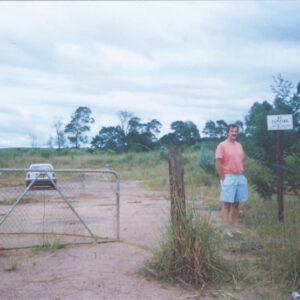
Athol on the site
that would become The Mushroom Farm.
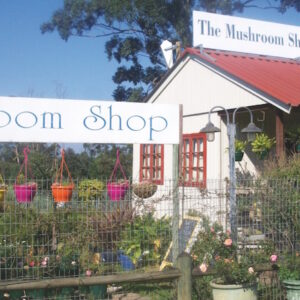
The Mushroom Farm as it is today