
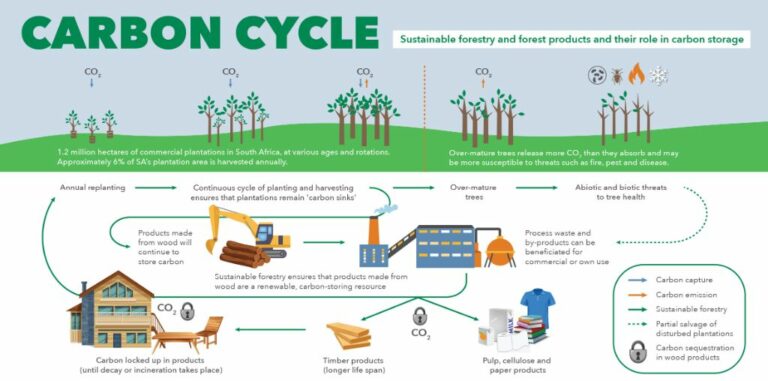
The carbon cycle graphic – harvested wood products have significant potential to mitigate climate change by locking up carbon emissions from the atmosphere.
With the world moving into digital overdrive, it is worth noting that paper stores carbon, making it good for the planet.
Paper has a fascinating history. Developed centuries ago, it has been through the mill – literally and figuratively – in terms of what it’s made from. It also has many interesting side stories: one story about paper that often goes untold is how it actually stores carbon, making it good for the planet.
Even when planted trees are harvested for their wood – for timber construction or for paper, packaging and tissue – the carbon remains locked in the wood fibres, remaining here for the life cycle of those products. This is just one of the reasons paper recycling is important – it keeps the carbon locked up for longer.
“To understand why paper and wood products are vital to a lower carbon footprint, we can borrow from Nobel Prize-winning physicist Richard Feynman’s assertion that trees don’t grow from the ground, they grow from the air,” says Jane Molony, executive director of the Paper Manufacturers Association of South Africa (PAMSA).
Many of us first learnt about photosynthesis in primary school – how plants absorb sunlight and carbon dioxide (CO2) to make food. Trees take in CO2 from the air, and water from the ground ‒ which also comes from the air at some point ‒ and convert this into growth (trunks, roots and leaves). Oxygen is then returned to the atmosphere. This carbon cycle is why trees of all kinds are such a vital part of keeping our planet regulated, offsetting greenhouse gas emissions and mitigating climate change.
“In South Africa, trees could be divided into two groups – indigenous trees in natural forests, and commercially and sustainably farmed trees in plantations. The latter were introduced some 100 years ago to protect natural forests, by providing farmed wood for productive purposes,” says Molony.
Plantation trees are essentially crops that are planted and replanted in rotation, with only 9% of the total tree count being harvested in any given year. This means there are always trees growing – at different stages of maturity – and these trees are contributing to the carbon cycle.
New chapters for wood
As the paper sector finds ways to diversify in the face of digitisation and to respond to reduced demands on printing and writing paper, chemists and chemical engineers are increasingly discovering the wonder of wood.
Wood is made up of cellulose, hemicellulose, lignin, sugars and extracts. The properties of these elements make them suitable ingredients in countless, low-carbon products.
For example, dissolving woodpulp – a purified form of cellulose – is suitable for chemical conversion into a range of products – it is spun into viscose and lyocell textile fibres for use in fashion and decorating textiles, cast into a film or regenerated into a sponge. Extremely versatile, it can also bind active medicinal ingredients or vitamins into palatable tablets, stabilise emulsions or increase viscosity – which is why it’s added to low-fat yogurt and lipstick.
Nanocellulose – tiny cellulose nanofibres – can be used in food supplements and edible packaging, or even as a composite for screens on electronic devices. Paper packaging manufacturers are exploring its use in weight reduction for paperboard without compromising strength and performance. The substance can also be applied as a recycling-friendly barrier coating instead of plastic.
By extracting more value from a tree, less goes to waste, Molony notes. “This opens the sector up to make even more meaningful contributions to sustainable product development and the circular economy.”
And by growing more trees and making innovative things from them we make our lives better, our jobs easier and our world more sustainable. *