
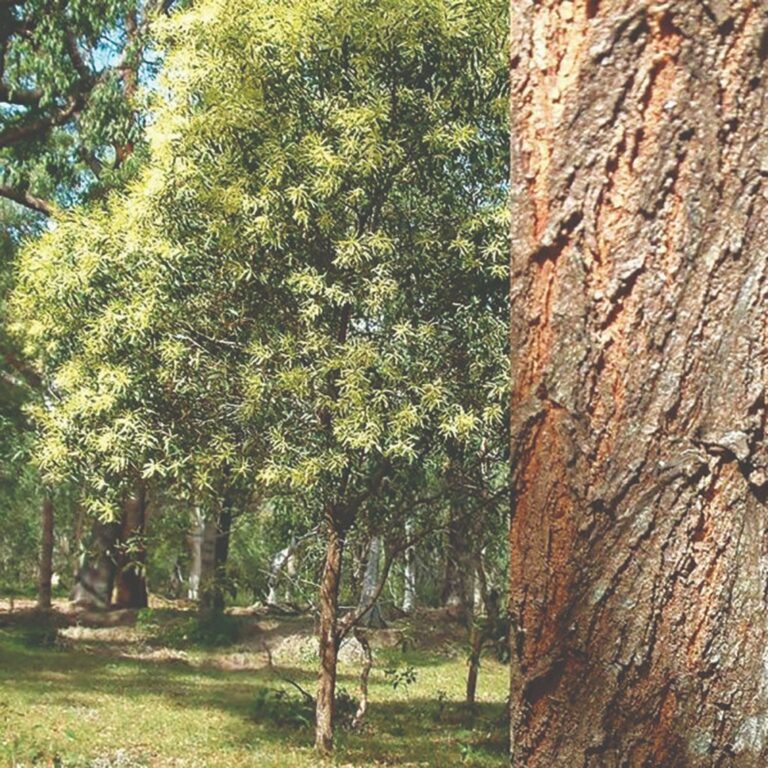
Shirley le Guern considers the low-down on the humble wattle tree.
The humble wattle tree that arrived from Australia in 1880 is often seen as something of a pest – a thirsty alien invader that threatens biodiversity. The flip side, however, is that this unwelcome immigrant has helped create a highly labour-intensive industry that offers significant growth in rural areas where unemployment is high and opportunities for emerging farmers low.
Fast-growing wattle trees were initially introduced by farmers as shelter for livestock and firewood. But, researchers discovered that the bark of the black wattle, in particular, contained high concentrations of polyphenolic chemicals, better known as tannins, which can be used for softening and curing leather.
Later, these same chemicals became essential ingredients for the production of resin products used to make adhesives for the manufacture of particleboard, plywood and cardboard as well as water flocculants and speciality products for the chemical, food and beverage sectors.
An added bonus is that black wattle also provides high-quality timber that’s ideal for chipping, pulping, building, fencing and making charcoal – another export product in its own right.
Today, South Africa is one of the chief exporters of wattle related products. An article published in Southern Forests: a Journal of Forest Science and penned by Julian Moreno Chan from the Institute for Commercial Forestry Research, places the country alongside Brazil as the world’s chief producer of wattle products.
In 2015, Chan estimated that timber provided 85% of revenue and bark 15% with the annual combined value of wattle extract from South Africa and Brazil worth about US$100-million and the total value of wattle wood chips worth around US$208-million.
One of local industry’s chief assets is the well-established Wattle Research Institute which, together with ongoing research and development from large wattle companies, continues to not only improve growing methods but also helps produce a number of new and innovative products.
One such company is Greytown based UCL, which produces a large range of products, including speciality leather tanning powders and wattle extracts, which are sold to Europe, America, Africa and Asia.
Established in 1924, UCL has grown from a wattle bark milling company to a large-scale enterprise specialising in the manufacture of wattle tannin extracts, sugar and pine lumber. According to UCL, the 130 000 hectares of commercial black wattle is grown by about 2 700 farmers, the majority of whom are small-scale growers.
Their factory operates seasonally from September to June and has a capacity of about 63 000 tons of bark per season from which it can manufacture roughly 18 000 tons of extract.
Sustainable management is critical, says the company. The bark, as well as the timber of the black wattle tree, is a much sought after commodity. For every ton of bark harvested the wattle tree also produces five tons of versatile hardwood timber. The trees are normally felled when they are 10 years old, after which the bark is removed, bundled and dispatched to the extract factory.
Another major player in the wattle industry is NCT, a marketing co-operative. Regarded as the largest forestry marketing organisation in southern Africa with a membership of close to 1 800 shareholding members, NCT is an international supplier of quality round wood timber, hardwood pulp and biomass chips.
Then there is NTE, a Pietermaritzburg based company with a colourful 100-year history that has been at the centre of the development of South Africa’s wattle bark extract industry.
In the late 90s, NTE was purchased by private wattle growers, enabling them to directly benefit from processing and marketing of bark extracts. NTE processes about 85 000 tons of wattle bark a year in its two factories, producing around 28 500 tons of finished product.
According to NTE, potential new markets for wattle bark extract include dust suppressants for the mining industry and water purification applications.
“With little room for growth in the leather industry and facing stiff competition from oil-based products in the adhesives market, the NTE team is busy developing new products and new markets. This includes potential new products for the mining industry. Another avenue with potential is using spent bark as biomass to produce energy. Spent bark is already used as fuel in the boilers at our Hermannsburg and Iswepe factories,” says a spokesperson for NTE.