
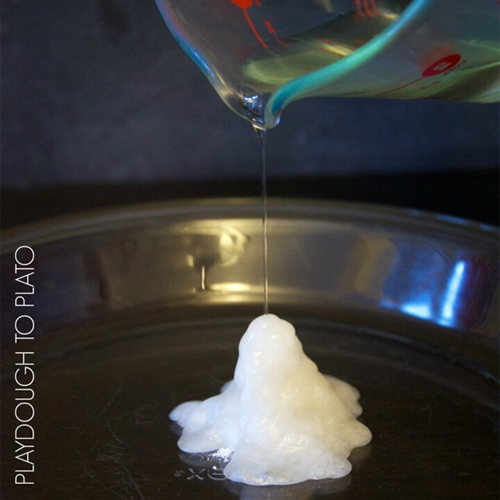
Did you know ice can be hot? In this experiment, you’ll find out how different chemicals freeze at different temperatures with two ingredients from your kitchen!
Supplies:
• 3 cups (705ml) white vinegar
• Small pot
• 3 to 4 tablespoons baking soda
• Spoon
• Plastic container with lid
The experiment:
In the sink, pour the vinegar into your pot. Slowly add the baking soda a little at a time, stirring with the spoon. Don’t pour it in too quickly, or you’ll get a messy baking soda volcano! Put the pot on the stove over a high heat. Boil the solution to concentrate it, until a crystal skin starts to form on the surface. This might take an hour or so and your liquid might change colour to yellow or brown. After the crystals form on the surface, remove the pot from the heat and carefully pour the solution into a container. Take a look at the liquid. Do you see crystals floating in it? If so, stir a very small amount of water or vinegar into the solution, just sufficient to dissolve the crystals. Put the lid on the container and put it in the fridge to chill. Check your pot – there should be some leftover crystals on the edge. Scrape some of these out and put them on a plate. After a couple of hours, take your liquid out of the fridge. It should be a liquid still. Drop the scrapings from your pot into the liquid and watch! Now touch the side of your container.
The outcome:
Your “ice” will be warm when it meets with more of the crystals.
Why it worked:
When you combine the vinegar and baking soda and put it over heat, you made a concentrated solution of sodium acetate. Sodium acetate freezes at 60°C. When you chilled it to below its melting point, it caused the liquid to form crystals, or hot ice.
Source: The 101 Coolest Simple Science Experiments by Rachel Miller, Holly Homer & Jamie Harrington.