
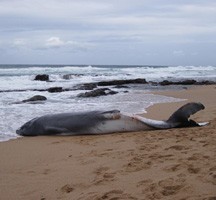
Two whales have been stranded on KZN beaches recently. Mike Anderson-Reade from the Sharks Board explains why.
Rough sea conditions associated with a strong cold front prevented the KZNSB from conducting routine servicing of the shark safety gear at most KZN beaches on Tuesday.
At about 8am the KZNSB received a call from the beach manager at Amanzimtoti to say that a small whale was entangled in the shark nets at that beach. A KZNSB boat deployed to find a 4m humpback whale calf that, unfortunately, was dead. The calf was towed offshore.
In a separate incident, the KZNSB received a call from the beach manager at Scottburgh to say that a small whale had stranded alive on the rocky shore near the caravan park. KZNSB staff investigated and found no evidence of shark net involvement in the stranding. The Scottburgh animal was also a humpback whale calf measuring just over 4m.
The KZNSB notified Ezemvelo KwaZulu-Natal Wildlife, the provincial authority responsible for attending to stranded marine mammals. Members of the public tried unsuccessfully to return the animal to the water but it would probably have had little chance of survival.

The local humpback whale population has recovered extremely well since commercial exploitation of the species ended in the previous century. In a paper published in 2011, University of Cape Town whale scientist, Dr Ken Findlay and co-workers published a study that showed the humpback whale population migrating past South Africa’s east coast to be growing at between 9% and 11.5% per annum, which is close to the maximum rate that is biologically possible.
Findlay also reported on a 2010 publication by the International Whaling Commission in which it was estimated that, in 2006, the humpback whale population off the African mainland of the south-western Indian Ocean exceeded 70% of its pre-exploitation size.
Not only is the local humpback whale population growing but so, too, are other populations in the southern hemisphere. In 2008 the IUCN (International Union for Conservation of Nature) Red List category for both the humpback and the southern right whale was changed from Endangered to Least Concern (Read more here).
As local whale populations grow so does the potential for strandings to occur, but also for there to be entanglements in fishing gear, including shark safety gear. The public is urged to notify the KZNSB on 031 566 0400 of any marine mammal entanglement. The KZNSB goes to great lengths – through the activities of its specially trained and equipped whale release teams – to free any whale found alive in the gear.
In addition, it is trialling commercially available acoustic deterrents that are intended to alert whales to the presence of the gear.
For more about the Sharks Board, visit www.shark.co.za
1 Comment
I am a retired sea captain who became obsessed in 1972 with solving the centuries-old mystery of why whales beach themselves. I finally did it. As it turns out, the answer is so simple that it can stated in only one word: BAROSINUSITIS
Barosinusitis in diving sea mammals is a pressure-related injury in the sinuses and air sacs located inside their heads. It is well-known that rapid and excessive changes in the surrounding water pressure can cause physical trauma in all diving mammals, including man.
Severe oscillations in pressure are common above the epicenter of certain shallow-focused undersea earthquakes, especially those located in the rift valley of mid-ocean ridges. Scientists called these seismoacoustic waves seaquakes until the 1950s when the name was changed to T-Phase Waves.
But not all earthquakes generate whale-dangerous T-Phase Waves (aka: seaquakes). Only events that occur in specific places and in a specific manner generate T-Phases that are dangerous to diving whales and dolphins.
Navy sonar, oil industry airguns, and underwater explosives also induce rapid and excessive changes in pressures surrounding the diving whales and dolphins. These man-made devices cause the exact same barosinusitis injury as caused by seismoacoustic waves generated by undersea earthquakes.
In toothed whales, the sinuses and air sacs serve as acoustic mirrors reflecting sound inside their heads in such a fashion to enable their echo-navigation system to function properly. An injury in this critical part of their biosonar system naturally disrupts echo-navigation, causing the animals to lose their normally excellent sense of direction. It also prevents them from diving and feeding themselves.
Lost at sea, the flow of the surface currents direct the injured whales/dolphins downstream from the point of injury. This control over the swim path of the injured sea mammals happens because water is 800 times denser than air. The increased density induces a powerful drag (resistance) to swimming in any direction except downstream with the flow. Thus, surface currents quickly point lost whales and dolphins headfirst into the path of least resistance or least drag.
The whales/dolphins will recover from a slight barotraumatic injury within a week or so. On the other hand, surface currents are likely to deposit those that do not recover on a sandy beach because current just happens to be the same energy that carries each grain of sand to build the beach in the first place. In general, whales/dolphins are directed to beaches that are building sand; not to beaches that are eroding.
Hungry sharks sense the whales/dolphins are in trouble. They move in close and wait for an opportunity to snatch any weakened pod member that falls behind.
Unable to navigate or dive and terrified by the pack of starving predators trailing them, the wounded whales/dolphins huddle together in a tight group for protection against sharks and killer whales. They swim downstream with the flow of the surface currents. The idea that individuals will follow a pod leader to the beach, or be drawn in by the distress calls of a beached member out of some sort of strong social bond is an over-glamorized false concept. Rather, individuals are highly-stressed and have no idea which way to swim to safety. They will follow any whale that ventures out in hopes that this individual knows the way to open water. They abide by a herd instinct, remaining close to their pod mates because they are in dreadful fear of becoming the next shark attack victim if they swim away from the herd. It appears as if the Pod has close social ties but in fact the action of each individual is focused on self preservation.
Said differently, it is the whale with the least fear that appears to human observors as a pod leader when in fact this individual is just as lost and confused as the rest of the pod.
Landmasses that extend out to sea opposing the flow of the surface currents, serve to trap sand, flotsam, seaweed, and lost sea mammals swimming with the flow. Cape Cod is the best example of such a natural trap in the United States. Cape Sorrel in Tasmania and Golden Bay in New Zealand are also natural traps for non-navigating whales/dolphins.
The reason for the increased strandings in Cape Cod during the 2011/2012 stranding season was the drastic increase in oil survey activity off the coast of Canada and West Greenland.
Normally the dolphins swim away from the oil survey boats long before they are injured; however, the rocky coast of northeast Canada and western Greenland consist mainly of one small cove after the next. The dolphins dart into these coves to avoid the loud booms. The survey vessel blocks their escape route when it tows the airguns along the openings of the coves.
The survey crews could prevent these deaths if they would simply reduce the volume of air supplied to the airguns as they cross the mouth of the coves.
I do not advocate the halt of oil exploration; however, I only ask that the oil industry and the US Navy stop denying the existence of barosinusitis and start listening to ways to prevent it. We can solve the problem by owning up to the truth and using simple precautions in the operations of oil survey vessels and sonar ships.
The reason the Navy and the oil industry will not admit barotrauma involves the numerous “best available scientific information” clauses in the Marine Mammal Protection Act of 1972. This law mandates that our governments protect marine mammals to the limits of the “best available scientific information.”
However, the control over developing “best available scientific information” is now solely in the hands of the US Navy and the oil industry since these two organizations fund 98% of all marina mammal research worldwide.
It’s like putting the tobacco industry in charge of lung cancer research.
The Navy and oil industry are not going to fund a study into barosinusitis since they are afraid they will shoot themselves in the foot. Instead, they fund research that covers up barotrauma in whales/dolphins.
As long as they can muddy the waters on the “best available scientific information,” they can skirt around the laws and do as they please. On the other hand, if they would fund research on preventing barotrauma and barosinusitis in marine mammals, simple procedures could be put in place that would allow the oil industry to extract offshore oil and the Navy to practice using sonar and still save the lives of the thousands of whales and dolphins that are killed every month.
Capt. David Williams, Chairman
Deafwhale Society, Inc.
http://www.deafwhale.com
(a 501-c non-profit whale research corporation devoted solely
to understanding why marine mammals beach themselves.)