
Science Question: How does propulsion work?
Rockets lift off with a principle called propulsion (or thrust). In this experiment, we will explore propulsion making out own ‘jet’ from a balloon to power a LEGO car!
Supplies needed:
- LEGO bricks
- Balloons
- Small tape measure
The Experiment:
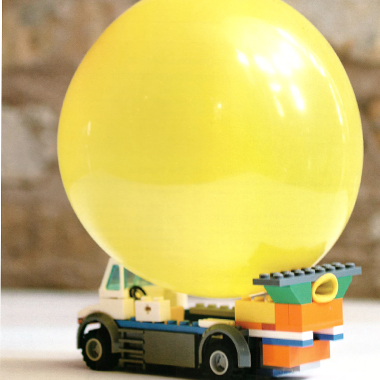
Build a car out of LEGO bricks, but leave an opening in the back of your car for your balloon jet. Give your car a little test drive to see how fast and how far it can go.
Blow up the balloon and insert it into the hole at the back of your toy car, so that the bottom of the balloon is facing the rear of the car. Put the car down, let go of the balloon and watch it go! Check the distance with the tape measure.
The Outcome:
The car went further when it was propelled by the balloon.
Why it worked:
When you let go of the balloon, air rushed out of it, causing the car to move in the opposite direction. It is propulsion. Rockets work in a similar way. Exhaust gas comes out of the rocket’s engine so fast that it propels the rocket up.
Variation:
Try racing your car on different surfaces. Does it go faster or slower on a rug? On the pavement? On a hill?
Did you know?
On average, every single person on earth owns 86 LEGO bricks! Do you have more than your share?
Try This!
Try combining six eight-stud LEGO bricks (2x4s) in different ways. How many different ways can you combine them? The folks at LEGO calculated this math problem and discovered the exact number of combinations is 915 103 765!
Source: The 101 Coolest Simple Science Experiments by Rachel Miller, Holly Homer & Jamie Harrington.