
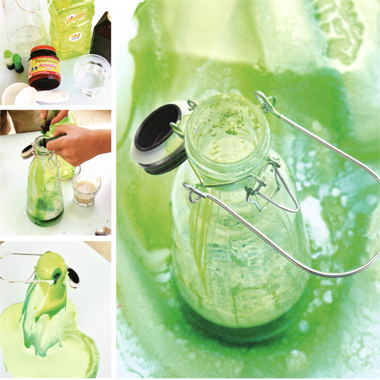
Science question: What happens when chemicals break down?
According to the law of thermodynamics, chemical compositions eventually fall apart. With hydrogen peroxide, we can watch the molecules break down. All we need is a catalyst – yeast.
Supplies needed:
- 1 cup (235ml) 3% hydrogen peroxide
- ¼ cup (60ml) bubble solution
- Tall bottle or vase
- Food colouring
- Cup
- ¼ cup (60ml) warm water
- 1 tablespoon (9g) active dry yeast (or 1 packet)
- Spoon
- A place to be messy
The experiment:
Pour the hydrogen peroxide and bubble solution into your tall bottle. Add a LOT of drops of food colouring (at least 15 drops). In a separate cup, mix the warm water and the yeast and stir with a spoon. Once the yeast is dissolved into the water, pour the yeast mixture into the bottle and stand back and watch!
The outcome:
A ton of bubbles emerge from the bottle.
Why it worked:
The yeast is the catalyst. It will break down the hydrogen peroxide. The bubble solution thickens the surface tension, capturing the escaping oxygen in lots and lots of frothy bubbles.
Variations:
- Replace the 3% hydrogen peroxide with an 8% for a bigger reaction. You may be able to find these at your local beauty supply store.
- If you want a less-mess version, consider sprinkling some yeast in the bottom of a dish, add a couple of tablespoons of hydrogen peroxide over the yeast. You will experience the experiment on a smaller scale.
Did you know?
Water is also a mixture of the hydrogen (2 atoms) and oxygen (1 atom) and is a relatively stable chemical. Unlike water, hydrogen peroxide has two oxygen atoms, making it less stable than water.
Idea: Try having an adult light a match over the potion as it is bubbling out of the bottle. Listen closely: what do you hear?
Source: The 101 Coolest Simple Simple Science Experiments.