
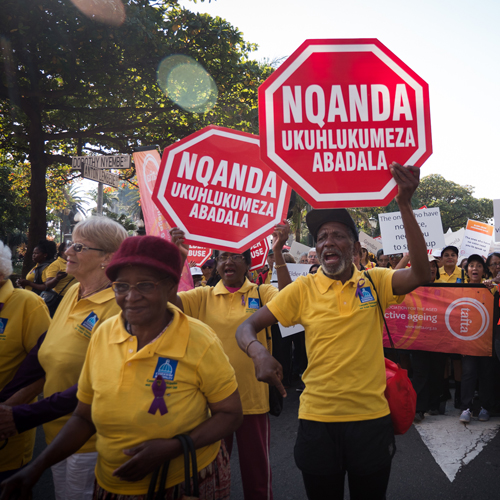
The Association for the Aged (TAFTA) and members of the Durban community took to the streets of central Durban yesterday (14 June) to start their two-day commemoration of World Elder Abuse Awareness Day, held annually around the world on 15 June.
The awareness walk, which was attended by over 500 members of surrounding Durban communities and Tafta elders, signifies a stand of solidarity by participants with victims of elder abuse. The event also aims to bring attention to the various forms of elder abuse taking place in society, explained Tafta CEO Femada Shamam. Shamam added that the elder care association had taken their commemorative event a step further with a lead up to the event with several Elder Abuse dialogues having taken place in and around Durban, by trained facilitators in the past month.
“Elder abuse is often described as a “silent epidemic”, not just here in South Africa, but around the world. Neglect and abuse of the elderly goes further than just physical, and it is Tafta’s aim to educate elders and the broader community on elder rights to ensure protection and dignity of the elderly, and a world free from discrimination. The dialogue sessions have been held in Sydenham, Inanda, Durban Central and Bellair which will now culminate in further sessions on 15 June 2018.”
“The issue of abuse, in particular, remains a subject of taboo. Our social work team is inundated with anonymous calls reporting abuse, but without the necessary knowledge of how to report abuse and fear of victimisation by both complainants and victims, it is extremely difficult for us to ensure perpetrators are taken to task,” Shamam explained.
For this reason, Shamam stated, Tafta, supported by the Department of Social Development and other elder care organisations, has initiated a series of Elder Abuse Dialogues in various Durban communities to train community-based facilitators on the critical issues that surround abuse. Some of the issues dealt with at the dialogues included investigating the level of understanding amongst elders around the various types of elder abuse, how elders in the dialogues sessions experienced abuse and what they wanted to see happen differently in the handling of elder abuse by authorities.
A Tafta trained facilitator, Gloria Rooks said she has shared her knowledge with her group and that cases of abuse had come up, which she preferred to keep confidential.
According to the World Health Organisation, more than one in 10 older adults may experience some type of abuse, but only one in five cases or fewer are reported. Shamam indicated that Tafta would remain committed to advocating for the rights of elders through community training initiatives such as the dialogue sessions and other awareness sessions.
“Elder abuse is recognised as a social problem of increasing magnitude. With an increase in the ageing population, it is also envisaged that the occurrence of elder abuse will undoubtedly increase. Although the protection of older persons falls within the scope of the Older Persons Act with the Department of Social Development being the administrator of this Act, the Department of Health perceives the abuse of older persons as a multifactorial issue requiring intervention from all sectors in a collaborative manner,” explained Elmarie van der Walt, Assistant Director: Geriatrics at the National Department of Health.
“The Department of Health acknowledges its role towards the protection of our older persons and this includes the protection of their dignity, hence the department’s development of an Elder Abuse Screening Tool to assist health care workers with the detection of possible abuse and to make appropriate referrals,” van der Walt added.
