
“If you want jobs, you’ll have to make them yourselves,” said Clem Sunter – former head of Anglo American’s gold division and chief scenario planner – back in 1999. Seventeen years later, how high on our agenda is entrepreneurship for our children?
Story Anne Schaeffer
It’s 2016 and we’re a little nervous. We’re unsettled about the impact of the economy, but most of all, we’re anxious about our children’s employment future in this, our beloved country, where jobs are scarce and becoming more so.
It’s well over a decade ago that Clem Sunter first warned about the dire need for “an entrepreneurial revolution, as the only way to turn our exclusive economy into an inclusive economy”. He contended that 20 000 successful entrepreneurs could realistically each add 25 people to their respective work forces. Do the maths – it’s an impressive number.
Sunter queried what schools were doing to prepare young people for life after school. Given the employment landscape, that preparation has to involve a sense of entrepreneurship and business skills. Not everyone listened, but some did and are integrating authentic programmes into their school life.
At The Wykeham Collegiate, their programme is driven by Sheryl Watson, Academic Co-ordinator: Commerce, and Susan Tasker, the Lady Principal. “As part of the business studies syllabus, pupils were expected to start up a business on paper, but it soon became apparent that they had no idea of how a business actually functioned.”
In 1998, the school developed a programme that would expose the pupils to what was happening in the real world. Grade 9 economic and management sciences (EMS) girls start and run their own businesses. “The girls have the option of being a sole trader or forming a partnership, and the project includes, among other things, conducting market research and selling their products or offering their services at the annual Market Day, competing against professional outside businesses.
“EMS is a practical subject and we aim to equip our girls with real-life skills for personal and community development,” says Tasker. The programme has sparked creative ideas and opportunities beyond the school, with many pupils going on to be successful entrepreneurs.
As a young person with no financial or other history, it’s difficult to gain credibility or get investors to believe in you. But it’s so much less daunting if you’ve acquired the basic business acumen and mindset. That’s where smart schooling comes in.
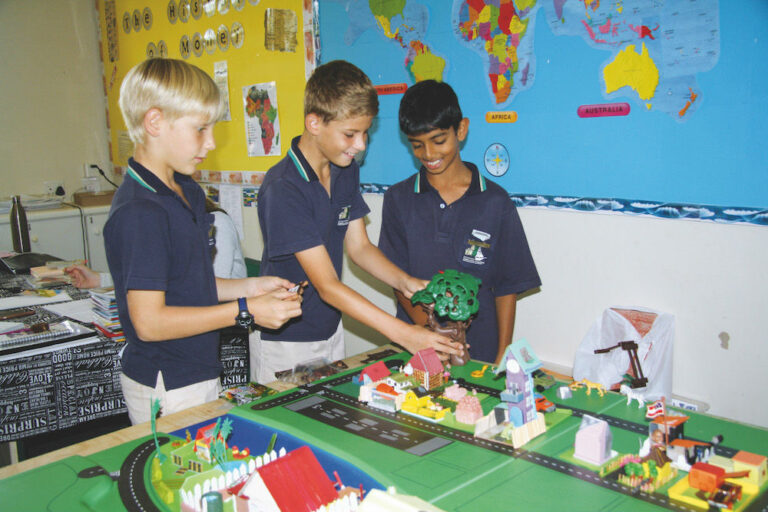
Graham Waite is deputy headmaster at Umhlanga College, where he’s developed an entrepreneurial programme called Real Life 4 Kids, a “game” aimed at 11 to 13-year-olds, which runs for a single term. The “game” is played in numerous schools across KwaZulu-Natal and beyond.
At Umhlanga College, Real Life 4 Kids is part of the Grade 5 year and it’s considered a real highlight. “The children love it and that’s part of the brilliance of it. For that one term, they are no longer pupils, but rather school employees. It’s their job to come to school, to do English, maths and so on. For that, we pay them a weekly wage of R100.”
Every element of the game involves some aspect of finance, and the school opens up a little bank account for them. They’re taught basic debit credit balance and earn 10% interest weekly on their money. They are rewarded financially for good work and penalised for poor.
The game reflects real life, providing staff with the opportunity to discuss why each pupil must pay R2 for transport to and from school, why they need medical aid, and why they don’t get paid if they don’t show up at school. Importantly, the game doesn’t disrupt the academic timetable – in maths class, it’s about interest and banking, in English, it’s about speech-making, as they prepare their campaigns to be mayor of “the city”.
From the outset, there’s a large board in the middle of the classroom – a landscape of the city. After about five weeks, the board comes into play and Waite auctions off the plots of land. The pupils then design and build houses on the plots, “pay” for them, and realise it’s in their best interest to build something superb. At the end of the game, Waite buys back everything, and the pupils learn about property appreciation. Effort is always rewarded.
Every element is another opportunity to learn, right to the game’s end, when pupils discover their net worth … and in steps SARS and taxes them. “That’s not fair,” is the cry. Sounds like life. *



1 Comment
Visit us at the Careers Expo at Kearsney College this Monday (29 February) from 12h30 to 17h00 to find out more about our Entrepreneurs in Training program which is being offered to scholars in grades 8 to 12 and prepares them to start and successfully run their own businesses … no more “paying school fees” in learning the hard way on how to run a successful business.