
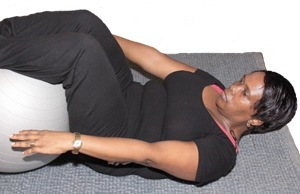
Think you can’t get rid of that bad back without surgery? Yes you can, writes Debbie Cameron.
Retired schoolteacher Mamsie Chiliza has suffered with a bad back for years. Yet she would never have considered joining a Pilates class (she’d always thought them indulgent!) had her orthopaedic specialist not recommended it.
It turned out to be the best move she’d ever made.
Mamsie had pain across the base of her back and down her right leg, which affected her movements and made her feel older than her 57 years. She also worried about what the future held for her health-wise.
According to statistics, 180 major surgery operations per 100,000 people are performed in South Africa, compared with 30-40 per 100,000 in Europe.
Conservative treatment of back pain can vary, and usually includes physiotherapy as part of a multidisciplinary treatment. The disc is not the only source of pain in the back, with ligaments, muscles, the smaller facet joints and the complex sacroiliac joint all capable of generating pain.
Physiotherapists regard exercise as one of the vital components of a healthy spine. The first “back school” was introduced in Sweden in 1969 by a man called Zachrisson Forsell. It included education about anatomy, optimal posture, ergonomics and back exercises. During the past ten years, the Pilates method of exercise has risen in popularity among physiotherapists worldwide.
The spine is designed to move, and Pilates exercises mimic these natural movements. If the normal function of a joint is disrupted through pain, spasm or stiffness, there is a decrease in the circulation and nutrient cycle around the area. Movement is essential for healing, but this is often not understood and is consequently neglected.
When we stand, the weight of our bodies compresses the discs and fluid flows out. Fluid restoration normally takes place at night. If a segment of the spine is immobile, then this nutrient cycle is retarded.
 Our posture can maintain the compression of the discs like the excessive lumbar lordosis that Mamsie has. One of Mamsie’s first Pilates’ tasks was to learn to control her pelvis in a neutral position.
All alignment centres from the pelvis: if the pelvic position is correct, so is the whole body. Pilates is known for strengthening the stabilising muscles of the spine but, as Mamsie discovered, you need to be taught where the postural muscles are.
Research recognised timing of muscles as a key component of healthy joints, so Mamsie was shown how to tighten her postural muscles on thought of movement – establish the mind-body-connection for which Pilates is famous.
Mamsie accomplished her basic training in three sessions and moved on to two classes a week; a mat class and a Pilates’ Wunda-chair class. In 2010 she won the award for Most Enthusiastic Pilates Pupil, for persevering, diligently following her programme and patiently striving to correct her technique.
She no longer needs a back operation, and has learned the importance of good posture.
Maimsie’s story
Mamsie Chiliza explains why she’s such a Pilates fan …
My association with the Pilates classes was by accident rather than a planned indulgence. But I have no regrets about being been referred to the Debbie Cameron team. My life has been rejuvenated and my health has improved so much I’m feeling like a “sweet 16” at the moment!
When my backache started, my orthopedic surgeon diagnosed a spinal cord disorder that affected my right leg, presumably because my nervous system was also somehow affected: scary stuff for a recently retired 57-year-old.
He assured me it was curable, and referred me to a physiotherapist.
I met the Debbie Cameron team in 2009, and had three consultations, before they recommended I should join the Pilates classes. I’ve never looked back.
Although I struggled with the exercises at first because my body was still very weak, my muscles adjusted quickly and grew stronger by the day.
Now I do most of the exercises with ease, and find it easy to do my routine work in my kitchen. I’ve learned what the correct posture is and practice that constantly.
This is all due to my Pilates classes, and I highly recommend them to anyone with similar back problems. Trust me, it really works.